What Is MMA Chemical?
MMA Chemical refers to Methyl Methacrylate, an organic compound with the molecular formula C₅H₈O₂. Its systematic name is methyl 2-methylprop-2-enoate.
At normal ambient conditions, MMA is typically encountered as a clear, colorless, volatile liquid with a characteristic odor. More importantly for manufacturing, its carbon-carbon double bond makes it a reactive monomer capable of polymerization.
When MMA molecules polymerize, they form polymethyl methacrylate (PMMA).
That simple transformation is commercially important:
Methyl Methacrylate → Polymerization → PMMA → Acrylic Products
MMA can also be incorporated into copolymers and resin systems when manufacturers need specific performance characteristics in coatings, adhesives, modifiers, and other formulated products.
Methyl Methacrylate Chemical Structure
The performance of Methyl Methacrylate begins with its molecular structure.
Its structural formula can be represented as:
CH₂=C(CH₃)COOCH₃
Two features are particularly important.
Carbon-Carbon Double Bond
The double bond provides the reactive site needed for addition polymerization. Under appropriate industrial conditions, MMA molecules link together and create long PMMA polymer chains.
Ester Functional Group
The ester group influences the polarity and chemical behavior of the molecule. Together with the methacrylate backbone, it contributes to the useful characteristics of the resulting acrylic polymers.
This molecular structure is one reason MMA works effectively as both a homopolymer monomer and a component in more complex acrylic formulations.
Important MMA Chemical Properties
Understanding MMA Chemical properties is important when selecting the material for polymerization, resin production, or formulation work.
Clear Appearance
MMA is normally supplied as a clear liquid. When properly processed into PMMA, it can produce acrylic materials with excellent optical transparency.
Low Viscosity
Its liquid form and relatively low viscosity make MMA practical to transfer, meter, mix, and process in properly designed industrial systems.
Polymerization Reactivity
The reactive double bond is one of MMA’s defining properties. It allows the monomer to polymerize efficiently when the required initiators and processing conditions are provided.
This reactivity is also why commercial MMA is generally stabilized with an inhibitor during storage and transportation.
Volatility and Flammability
MMA is a volatile, flammable liquid. Industrial users therefore need appropriate ventilation, ignition control, compatible equipment, and storage practices based on the supplier’s current safety documentation.
Limited Water Solubility
Methyl Methacrylate has limited solubility in water but is compatible with many organic systems. This behavior is relevant when MMA is incorporated into different resin and formulation processes.
How Is Methyl Methacrylate Produced?
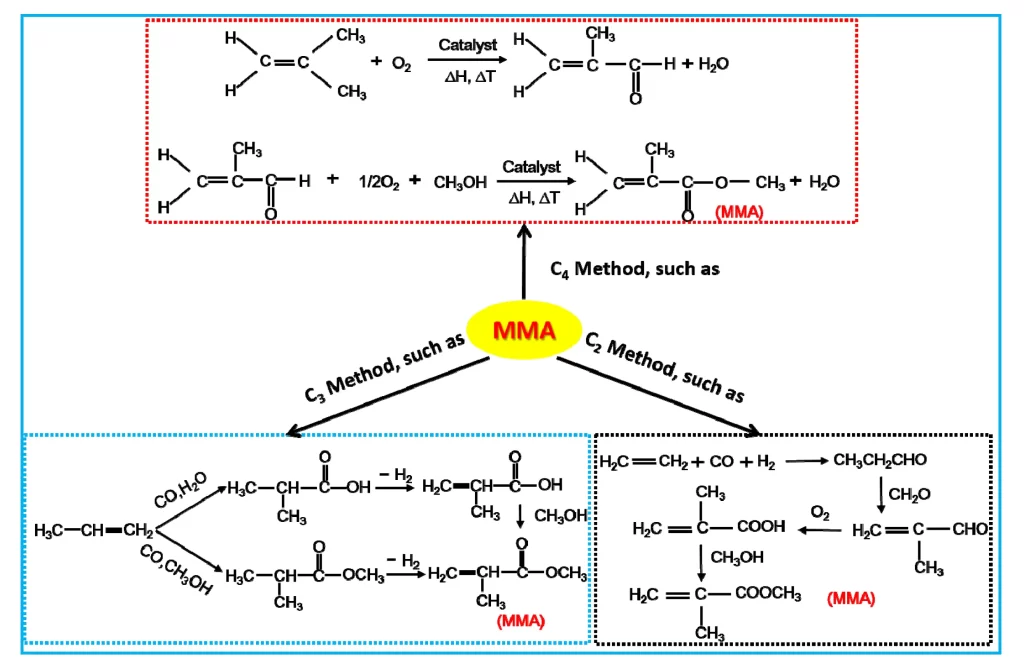
Commercial Methyl Methacrylate can be manufactured through several industrial routes. The exact technology depends on feedstock availability, plant design, process economics, environmental considerations, and the technology selected by the producer.
One established route is the acetone cyanohydrin process. Other commercial technologies use C4 feedstocks, while newer routes can use ethylene-derived feedstocks.
Acetone Cyanohydrin Process
The traditional acetone cyanohydrin, or ACH, route starts with acetone and hydrogen cyanide to form acetone cyanohydrin.
Further reaction and esterification steps eventually produce MMA. The crude product then requires separation and purification before it is suitable for commercial applications.
The ACH process has a long industrial history, but handling hazardous feedstocks and managing process by-products are important considerations.
C4-Based Routes
C4 technologies can use feedstocks such as isobutylene or tert-butanol. These routes follow a different sequence of chemical conversions before the required methacrylate intermediate is esterified to produce MMA.
They provide manufacturers with an alternative to the traditional ACH route.
Ethylene-Based Production
Commercial technology has also been developed around ethylene-derived feedstocks. Such routes can offer advantages in feedstock utilization and process design depending on the plant and regional raw-material economics.
Regardless of the route, the final stages must deliver MMA that meets the purity, stability, and inhibitor requirements of the intended customer application.
Why Purity Matters in MMA Chemical
For industrial users, purchasing MMA isn’t simply a matter of ordering a chemical with the correct name.
The quality of the monomer can affect what happens inside the customer’s production line.
Depending on the application, buyers may need to consider:
- MMA purity
- Water content
- Color
- Acidity
- Inhibitor concentration
- Storage stability
- Batch consistency
- Supplier documentation
In PMMA production, for example, unwanted impurities or inconsistent feed quality can interfere with process control and the quality of the finished polymer.
For this reason, buyers should evaluate a supplier based on specifications and quality consistency rather than price alone.
What Is Methyl Methacrylate Used For?
The most important use of Methyl Methacrylate is PMMA production, but that is only one part of the market.
Major MMA Chemical applications include:
- PMMA and acrylic products
- Cast and extruded acrylic sheets
- Coatings and acrylic resins
- Adhesives
- Construction materials
- Automotive components
- Lighting and optical products
- Medical and dental materials
- Specialty polymer formulations
The required MMA grade and processing conditions can vary between these applications, which makes technical specifications important during procurement.
PMMA manufacturing is the application most closely associated with MMA.
Once polymerized, MMA produces a thermoplastic valued for its combination of transparency, weatherability, surface appearance, and relatively low weight.
PMMA is used to manufacture products such as:
- Clear acrylic sheets
- Signage
- Display panels
- Skylights
- Lighting covers
- Machine guards
- Transparent partitions
- Retail fixtures
- Optical components
Acrylic can replace glass in applications where manufacturers need transparency while reducing weight and gaining greater fabrication flexibility.
Methyl Methacrylate is also an important building block for acrylic coating resins.
Depending on the formulation, MMA-containing polymers can contribute to properties such as:
- Outdoor durability
- Gloss retention
- Hardness
- UV and weather resistance
- Surface appearance
These characteristics make acrylic chemistry relevant to architectural, automotive, protective, and specialty coating systems.
The final coating performance does not depend on MMA alone. Polymer design, comonomers, pigments, additives, application conditions, and curing or film formation all influence the finished system.
MMA-based adhesive technology is particularly useful where manufacturers need strong bonding between engineering materials.
Applications can include bonding:
- Metals
- Composites
- Selected plastics
- Fabricated components
These adhesive systems are used in sectors such as transportation, construction, marine fabrication, and industrial assembly.
Their value comes from the overall adhesive formulation, where methacrylate chemistry can support rapid strength development and durable structural bonding.
MMA-derived PMMA is well suited to automotive applications where optical quality and weather resistance matter.
Common examples include:
- Headlamp lenses
- Taillight components
- Interior light guides
- Instrument covers
- Decorative transparent components
- Display-related parts
Reducing component weight is also important in modern vehicle design. Acrylic materials can provide optical performance without the weight associated with equivalent glass components in suitable applications.
Construction and signage industries are major users of acrylic materials made from MMA.
Applications include:
- Illuminated signs
- Advertising displays
- Architectural glazing
- Decorative panels
- Skylights
- Transparent barriers
- Retail installations
Outdoor applications particularly benefit from PMMA’s transparency and resistance to weathering.
Methyl methacrylate chemistry also has established uses in medical and dental materials.
Depending on the formulation and regulatory requirements, MMA-related materials can be found in applications such as dental prosthetics and certain bone cement systems.
These are specialized uses where material specifications, formulation, processing, and regulatory compliance are particularly important.
Industrial MMA should never be assumed to be suitable for a medical application simply because the underlying chemical is the same. Buyers must source the appropriate grade and documentation for the intended use.
MMA Chemical vs PMMA: What’s the Difference?
MMA and PMMA are closely related, but they are not the same material.
| Feature | MMA | PMMA |
|---|
| Full name | Methyl Methacrylate | Polymethyl Methacrylate |
| Material type | Monomer | Polymer |
| Typical form | Liquid | Solid thermoplastic |
| Main role | Chemical raw material | Finished or semi-finished plastic material |
| Common use | Polymer and resin production | Sheets, lenses, displays and fabricated components |
In simple terms, MMA Chemical is the building block, while PMMA is one of the major materials made from that building block.
This distinction is important for buyers. A company manufacturing acrylic sheets may purchase MMA as its raw material, while a fabricator may instead purchase finished PMMA sheets.