MMA Chemicals

What Is Methyl Methacrylate (MMA)? Uses, Properties, Structure & Industrial Applications

What Is Methyl Methacrylate (MMA)? Uses, Properties, Structure & Industrial Applications

Methyl methacrylate (MMA) is a clear, colorless liquid monomer with the chemical formula C₅H₈O₂. It serves as the primary building block for polymethyl methacrylate (PMMA), a durable and transparent plastic commonly known as acrylic, Plexiglas, or Lucite. Because of its excellent optical clarity, weather resistance, and long-term durability, MMA has become an essential raw material in industries such as construction, automotive, healthcare, electronics, and consumer products.

Manufacturers use methyl methacrylate to produce acrylic sheets, protective coatings, adhesives, sealants, medical devices, and a variety of specialty materials. In addition, MMA offers strong polymerization properties, making it a valuable component in the production of lightweight and high-performance products.

In this guide, you’ll learn about the chemical structure and formula of methyl methacrylate, its key physical and chemical properties, and its most important industrial applications. Furthermore, you’ll discover how MMA supports modern manufacturing and why it remains one of the most widely used monomers in the acrylic and polymer industries worldwide.

Chemical Structure of MMA (Methyl Methacrylate Monomer)

Methyl methacrylate (MMA) has the molecular formula C₅H₈O₂ and the IUPAC name methyl 2-methylprop-2-enoate. Its chemical structure gives MMA the unique properties that make it valuable in acrylic manufacturing, coatings, adhesives, and polymer production.

The structure of MMA contains three important components:

  • A vinyl double bond (CH₂=C(CH₃)), which allows MMA to undergo polymerization.

  • An ester functional group (COOCH₃) that contributes to the material’s stability and performance.

  • A methyl group (CH₃) attached to the double-bonded carbon atom.

As a result, MMA belongs to the acrylic ester family and serves as the primary building block for polymethyl methacrylate (PMMA), commonly known as acrylic.

Why MMA’s Chemical Structure Matters

The vinyl double bond is the most reactive part of the MMA molecule. Therefore, it enables free-radical polymerization, allowing MMA molecules to join together and form long polymer chains. This process creates PMMA, a transparent and durable plastic used in acrylic sheets, lenses, display panels, and protective barriers.

In addition, the ester group and methyl side chain contribute to the excellent clarity, weather resistance, and stability of PMMA. Because of these characteristics, MMA-based materials perform well in demanding industrial and outdoor applications.

Key Features of MMA’s Structure

  • Enables rapid polymerization into PMMA

  • Supports excellent optical clarity

  • Provides strong weather and UV resistance

  • Contributes to long-term material stability

  • Helps create lightweight and durable acrylic products

Consequently, the chemical structure of methyl methacrylate plays a critical role in determining the performance, durability, and versatility of acrylic materials used across multiple industries.

MMA Chemical Formula and Molecule

  • Chemical Formula: C₅H₈O₂
  • Molecular Structure: CH₂=C(CH₃)COOCH₃

Below is a simplified illustration of MMA’s molecular structure:

Chemical Formula: C₅H₈O₂ Molecular Structure: CH₂=C(CH₃)COOCH₃

(Methyl methacrylate contains a carbon carbon double bond (left) and a methyl ester group (right).)

Because of this structure, MMA is classified as an acrylic monomer. When polymerized, MMA molecules link via the double bond to form long chains of PMMA, a rigid thermoplastic polymer.

Physical and Chemical Properties of MMA

Methyl methacrylate (MMA) has several important physical and chemical properties that make it valuable for industrial and commercial applications.

Physical Properties of MMA

  • Appearance: Clear, colorless liquid

  • Odor: Sharp, sweet smell that can be detected even at low concentrations

  • Density: Approximately 0.94 g/cm³, making it lighter than water

  • Boiling Point: Approximately 100 – 101°C (212–214°F)

  • Melting Point: Approximately -48°C (-54°F), which means MMA remains liquid at room temperature

  • Solubility: Slightly soluble in water and highly compatible with most organic solvents

  • Vapor Pressure: Relatively high, so it evaporates easily and can form flammable vapors

  • Flash Point: Around 10°C (closed cup), making MMA a highly flammable liquid

  • Stability: Manufacturers add inhibitors such as hydroquinone to prevent unwanted polymerization during storage and transportation

Key Chemical Properties of MMA

Polymerization Behavior

MMA readily undergoes free-radical polymerization. As a result, manufacturers can convert it into polymethyl methacrylate (PMMA) or combine it with other monomers such as styrene, butadiene, and acrylic compounds to produce specialty resins.

Low Viscosity

MMA has a low viscosity, which makes handling, mixing, and processing easier. In its monomer form, it remains a clear liquid. However, once polymerization begins, it transforms into a strong solid material.

Excellent Optical Clarity

One of MMA’s most valuable characteristics is its ability to produce highly transparent PMMA. In fact, PMMA can transmit more than 90% of visible light. Therefore, manufacturers frequently use it in windows, lenses, display panels, and acrylic sheets.

Chemical Stability

MMA and PMMA offer excellent resistance to UV radiation and weather exposure. As a result, acrylic products maintain their clarity and appearance for extended periods without significant yellowing or degradation.

Reactivity

The carbon-carbon double bond within MMA makes it highly reactive during polymerization. However, proper stabilization allows manufacturers to store MMA safely for extended periods. Once exposed to heat, light, or suitable initiators, MMA rapidly forms durable polymer chains.

PropertyMethyl Methacrylate (MMA)
AppearanceClear, colorless liquid
FormulaC₅H₈O₂
Molecular Weight100.12 g/mol
Boiling Point100–101°C
Density0.94 g/cm³
Flash Point10°C
Water SolubilityApproximately 1.6 g/L at 20°C
StabilityStabilized with inhibitors
PolymerizationEasily polymerized through free-radical initiation
Optical ClarityExcellent after polymerization

Table: Key physical and chemical properties of methyl methacrylate (approximate values).

Importance of MMA’s Structure and Properties

The combination of MMA’s vinyl double bond and ester group gives PMMA several important performance advantages.

High Clarity and Gloss

First, MMA produces exceptionally clear acrylic materials. Consequently, PMMA offers excellent transparency and an attractive glossy appearance.

Strong Durability

In addition, PMMA provides better hardness and scratch resistance than many common plastics. Therefore, manufacturers often choose it for demanding applications.

Lightweight Performance

PMMA weighs approximately half as much as traditional glass. As a result, it works well in portable products, display systems, and large glazing applications.

Excellent Weather Resistance

Unlike some plastics, PMMA resists yellowing and maintains its appearance during long-term outdoor exposure. Furthermore, it performs well under UV radiation and changing weather conditions.

Easy Processing

Manufacturers can cast, extrude, thermoform, and machine acrylic materials with relative ease. Likewise, they can polymerize MMA directly in molds to create cast acrylic sheets and custom products.

These advantages stem directly from MMA’s chemical structure and its ability to form a stable, transparent polymer network.

Types of MMA Products and Formulations

Manufacturers use MMA in several forms depending on the final application.

MMA Monomer

MMA monomer is the pure liquid form of methyl methacrylate. Manufacturers primarily use it to produce PMMA and other acrylic-based products. Additionally, it can serve as a reactive component in specialty adhesives and coatings.

MMA Resins

MMA resins contain partially polymerized acrylic materials combined with MMA monomer. As a result, these formulations work well in coatings, flooring systems, adhesives, and sealants.

PMMA Acrylic Polymers

PMMA polymers are the finished solid products created from MMA. Manufacturers typically sell them as pellets, granules, sheets, rods, or blocks for further processing.

MMA Copolymers

Manufacturers often combine MMA with monomers such as styrene, butadiene, and vinyl chloride to create materials with specialized properties. Consequently, these copolymers can offer improved impact resistance, flexibility, or chemical performance.

MMA Emulsions

MMA emulsions are water-based acrylic dispersions used in paints, coatings, and construction products. Because they are water-based, they provide easier application and lower solvent content.

Since MMA is a liquid monomer, suppliers typically ship it with stabilizers. After delivery, manufacturers add initiators such as peroxides or UV curing systems to start polymerization when needed. This controlled process helps produce adhesives, acrylic sheets, coatings, and other MMA-based products efficiently.

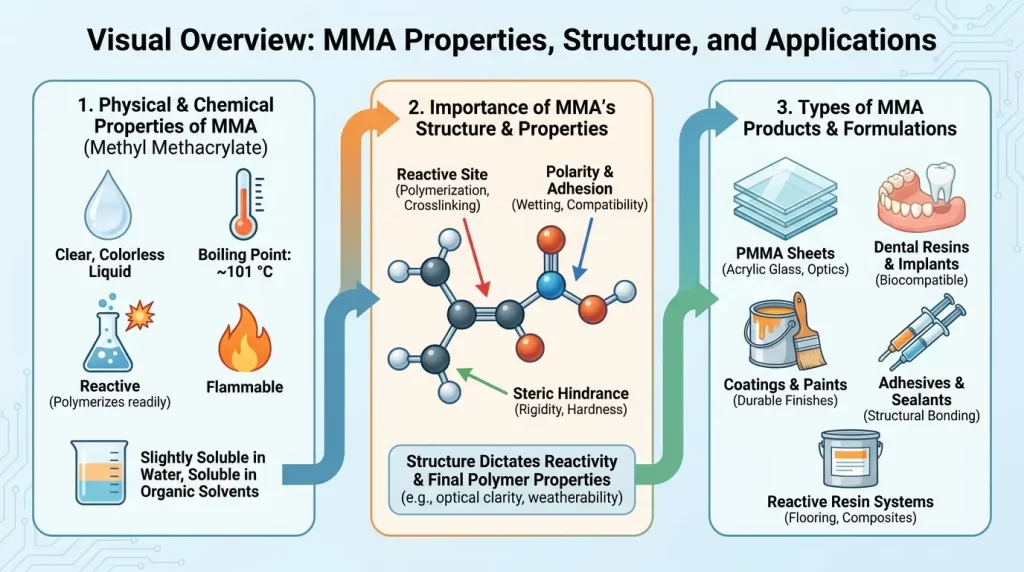
Physical and Chemical Properties of MMA Importance of MMA's Structure and Properties Types of MMA Products and Formulations

Industrial Applications of Methyl Methacrylate

Thanks to its versatility, durability, and excellent optical properties, methyl methacrylate (MMA) plays an important role in many industries. Manufacturers use MMA to produce acrylic plastics, coatings, adhesives, medical products, and specialty materials. As a result, MMA has become one of the most valuable raw materials in modern manufacturing.

Acrylic Sheet and Plastic Manufacturing

The largest application of MMA is the production of polymethyl methacrylate (PMMA), commonly known as acrylic. Manufacturers polymerize MMA to create clear, rigid sheets and molded plastic products used in various industries.

Common applications include:

  • Architectural glazing, skylights, and windows

  • Retail displays and point-of-purchase stands

  • Light fixtures and exhibition cases

  • Eyewear lenses and optical components

  • LCD screens and camera lenses

  • Machine guards, safety shields, and aquarium tanks

Because PMMA offers excellent transparency and durability, it serves as a lightweight alternative to glass. In addition, manufacturers can easily cut, drill, bend, and fabricate acrylic products for custom applications.

Coatings and Paints

MMA is also a key ingredient in many high-performance coatings and paints. These coatings provide long-term durability, weather resistance, and excellent surface protection.

Major applications include:

  • Industrial coatings for machinery and equipment

  • Protective coatings for pipelines and metal structures

  • Architectural paints for commercial and residential buildings

  • Road marking paints for highways and airports

  • Automotive clear coats and specialty finishes

Furthermore, MMA-based coatings cure quickly and maintain their color, gloss, and adhesion for extended periods.

Adhesives and Sealants

MMA monomer plays an important role in the production of structural adhesives and sealants. These products create strong and durable bonds across different materials.

Key benefits include:

  • Fast curing times

  • Excellent bond strength

  • High resistance to moisture and chemicals

  • Long-term durability under extreme temperatures

Consequently, industries use MMA adhesives in automotive assembly, construction projects, composite manufacturing, and medical devices.

Automotive and Transportation

The automotive and transportation sectors rely heavily on MMA-based materials because they combine lightweight performance with exceptional clarity.

Common uses include:

  • Headlamp and tail lamp lenses

  • Dashboard components

  • Instrument panels

  • Interior trim pieces

  • Exterior decorative panels

  • Aircraft and marine windows

As manufacturers continue to reduce vehicle weight, MMA-based acrylic materials help improve fuel efficiency while maintaining strength and appearance.

Construction and Flooring

The construction industry uses MMA in several applications because it offers rapid curing and excellent durability.

Important applications include:

  • Industrial floor coatings

  • Decorative flooring systems

  • Concrete repair materials

  • Waterproof roof coatings

  • Deck protection systems

  • Joint sealants and structural bonding products

Moreover, MMA flooring systems create seamless surfaces that resist chemicals, moisture, and heavy traffic.

Medical and Dental Applications

MMA also supports a wide range of medical and dental applications.

Examples include:

  • PMMA bone cement for joint replacement procedures

  • Dental prosthetics and dentures

  • Orthopedic materials

  • Intraocular lenses

  • Medical optical devices

Because PMMA provides excellent clarity and biocompatibility, healthcare professionals use it in many critical applications.

Consumer and Specialty Products

Beyond industrial applications, MMA contributes to numerous consumer products and specialty technologies.

These include:

  • Cosmetic packaging

  • Acrylic nail products

  • Electronic display panels

  • Electrical insulation materials

  • Light guides

  • Resin-based 3D printing materials

In addition, manufacturers continue to develop new MMA-based products for emerging technologies and advanced manufacturing processes.

Why Industries Prefer MMA

Many industries choose MMA because it combines transparency, durability, weather resistance, and chemical stability in a single material. Furthermore, MMA allows manufacturers to create products that are lightweight, attractive, and long-lasting.

As a result, MMA remains the foundation of many acrylic plastics, coatings, adhesives, and specialty materials used around the world. Whenever manufacturers need a clear, weather-resistant plastic or a durable protective coating, MMA chemistry often provides the ideal solution.

Advantages of Methyl Methacrylate:

Industries around the world choose methyl methacrylate (MMA) because it combines transparency, durability, versatility, and long-term performance. As a result, manufacturers use MMA in acrylic sheets, coatings, adhesives, automotive components, medical devices, and construction materials.

Outstanding Optical Clarity

One of the biggest advantages of MMA is its exceptional optical clarity. When polymerized into PMMA, it can transmit up to 92% of visible light. Therefore, manufacturers frequently use acrylic materials in windows, display panels, lenses, skylights, and signage applications.

High Durability

MMA-based materials offer excellent durability and scratch resistance. In addition, PMMA maintains its strength and appearance for many years, making it suitable for demanding indoor and outdoor environments.

Excellent Weather and UV Resistance

Unlike many plastics, PMMA resists yellowing and degradation caused by sunlight. As a result, products made from MMA perform well in outdoor conditions and maintain their appearance for extended periods.

Lightweight Performance

PMMA weighs approximately half as much as traditional glass. Consequently, manufacturers prefer acrylic materials in transportation, architecture, and display systems where reducing weight is important.

Versatility Across Applications

Another major benefit of MMA is its versatility. Manufacturers can polymerize MMA into rigid plastics, formulate it into coatings, or use it in high-performance adhesives. Furthermore, they can combine MMA with other monomers to create materials with customized properties.

Fast Curing Properties

MMA-based adhesives and coatings cure rapidly, often within minutes. Therefore, manufacturers can increase production efficiency and reduce installation time in construction and industrial applications.

Chemical Resistance

PMMA offers good resistance to many household chemicals and environmental conditions. As a result, MMA-based products perform reliably in a wide range of commercial and industrial settings.

Thermal Stability

Although PMMA is not as heat resistant as polycarbonate, it performs well at moderate temperatures. In most applications, acrylic materials maintain their shape and strength up to approximately 70–80°C.

Attractive Surface Finish

MMA-based plastics and coatings provide a smooth, glossy, and premium appearance. Because of this, manufacturers frequently use them in products where aesthetics are important.

Why These Advantages Matter

These performance benefits help manufacturers create durable, lightweight, and visually appealing products. For example, acrylic signs remain clear and bright for years, while MMA adhesives can replace mechanical fasteners in certain applications and simplify assembly processes.

Sourcing and Quality of MMA Monomer

When purchasing methyl methacrylate monomer, manufacturers focus on quality, consistency, and safety. Choosing a reliable supplier helps ensure better product performance and smoother production operations.

Purity and Inhibitor Content

High-quality MMA contains stabilizers that prevent unwanted polymerization during storage and transportation. Common inhibitors include hydroquinone and MEHQ. In addition, premium MMA typically contains low levels of impurities, which improves processing performance and product quality.

Packaging and Storage

Suppliers usually ship MMA in steel drums, ISO tanks, or bulk tankers. To maintain stability, they use oxygen-controlled storage conditions and protect the material from excessive heat and direct sunlight.

Safety Documentation

Reliable suppliers provide Safety Data Sheets (SDS) and Certificates of Analysis (CoA) for every shipment. These documents help buyers verify product specifications, purity levels, inhibitor content, and handling requirements.

Supplier Reliability

Many industrial users prefer experienced chemical suppliers that offer technical support, consistent quality, and dependable delivery schedules. Consequently, strong supplier relationships help reduce operational risks and improve production efficiency.

Regenerated and Recycled MMA

Some manufacturers now offer regenerated MMA produced from recycled acrylic materials. However, buyers should verify purity levels and performance standards before using recycled MMA in critical applications.

Sustainable and Bio-Based MMA

As sustainability becomes increasingly important, researchers continue to develop bio-based MMA alternatives. Therefore, the industry may see greater adoption of environmentally friendly MMA products in the coming years.

Importance of High-Quality MMA

By selecting high-purity MMA and following proper handling practices, manufacturers can improve product quality, reduce defects, and maintain safe production environments. Furthermore, high-quality MMA supports better transparency, stronger polymerization, and improved long-term performance.

Future Trends and Industry Growth

The global demand for methyl methacrylate continues to grow as industries seek lightweight, durable, and high-performance materials. As a result, MMA remains a key component in many expanding markets.

Growing Market Demand

Demand for acrylic sheets, coatings, adhesives, and specialty plastics continues to increase across Asia, Africa, Europe, and North America. In addition, infrastructure development, automotive production, and consumer electronics growth are creating new opportunities for MMA manufacturers.

Advanced Acrylic Materials

Manufacturers are developing new acrylic copolymers and performance-enhanced formulations. For example, impact-modified acrylics and UV-curable materials offer improved durability and faster processing.

Growth in 3D Printing

The 3D printing industry increasingly uses acrylic-based resins that contain MMA and related acrylates. Consequently, demand for specialized MMA formulations continues to expand.

Recycling and Sustainability

Chemical recycling technologies now allow manufacturers to recover MMA from waste PMMA materials. Likewise, bio-based production methods are helping reduce dependence on traditional petrochemical feedstocks.

Low-VOC Coatings and Green Technologies

As environmental regulations become stricter, manufacturers continue to develop water-based and UV-cured MMA coatings. These products help reduce VOC emissions while maintaining strong performance characteristics.

Expanding Medical Applications

MMA continues to play an important role in healthcare. Ongoing advancements in bone cements, dental materials, and medical-grade acrylic products are creating additional opportunities for growth.

Future Outlook

Methyl methacrylate remains one of the most important raw materials in modern manufacturing. Because of its versatility, durability, and adaptability, new applications continue to emerge across industries. As demand for advanced plastics, coatings, adhesives, and sustainable materials grows, the global MMA market is expected to expand significantly over the coming years.

Advantages of Methyl Methacrylate (Why Industries Use MMA) Sourcing and Quality of MMA Monomer Future Trends and Industry Growth

Conclusion

Methyl methacrylate (MMA) is one of the most important raw materials in the modern chemical industry. Thanks to its unique molecular structure and versatile properties, MMA helps manufacturers produce durable, lightweight, and transparent materials for a wide range of applications.

As the primary building block of polymethyl methacrylate (PMMA), MMA plays a critical role in the production of acrylic sheets, coatings, adhesives, medical devices, and automotive components. In addition, its excellent optical clarity, weather resistance, and strong polymerization performance make it a preferred choice across multiple industries.

Furthermore, MMA supports the development of innovative products that require strength, durability, and long-term performance. Whether manufacturers produce architectural glazing, industrial coatings, acrylic displays, or high-strength adhesives, MMA continues to deliver reliable results.

As demand for advanced plastics, sustainable materials, and high-performance coatings continues to grow, the importance of methyl methacrylate is expected to increase. Therefore, MMA will remain a key material in modern manufacturing and industrial development for years to come.

FAQs

What is methyl methacrylate (MMA) used for?

MMA is mainly used to make acrylic plastics (like Plexiglas) by polymerization. It’s also used in high-performance coatings, road-marking paints, strong adhesives and sealants, dental and bone cements, and specialty polymers. Industries such as construction, automotive, aerospace, electronics, and healthcare use MMA-derived materials.

What is the chemical formula and structure of MMA?

The formula is C₅H₈O₂. Structurally, MMA is CH₂=C(CH₃)COOCH₃ – a vinyl double bond attached to an ester (methyl ester of methacrylic acid). This structure allows MMA to polymerize into PMMA.

Why is MMA important for acrylic sheet manufacturing?

MMA polymerizes into poly(methyl methacrylate) (PMMA), which forms clear, shatter-resistant sheets. Acrylic made from MMA is half the weight of glass and resists yellowing. This makes it ideal for signs, displays, windows, and lenses where clarity and light weight are important.

What are the key properties of MMA-based polymers?

Polymers made from MMA (acrylics) have high optical clarity, good impact and scratch resistance, excellent UV/weather stability, and chemical resistance. They also have a pleasant surface gloss and can be easily molded or machined.

Is MMA the same as PMMA?

No. MMA is the liquid monomer (methyl methacrylate) used in polymerization. PMMA (poly(methyl methacrylate)) is the solid polymer formed when many MMA molecules link together. In short, MMA → polymerizes into → PMMA (acrylic plastic).

How should MMA be stored and handled?

MMA monomer is flammable and has health hazards (it’s an irritant). It should be stored in sealed, labeled containers with an inhibitor, away from heat and sparks. Use in a well-ventilated area, and follow safety data sheet (SDS) guidelines (gloves, goggles, ventilation, etc.).

What industries commonly use MMA chemicals?

Major industries using MMA include:

  • Construction/Architecture: windows, panels, signage
  • Automotive & Transportation: lights, trim, gauges
  • Coatings/Paints: protective and decorative coatings
  • Medical/Dental: bone cement, implants, prosthetics
  • Electronics: displays, optical devices
  • Consumer Goods: aquariums, bathtubs, furniture
    Basically, any industry requiring clear, durable plastics or strong fast-setting adhesives can use MMA.
What Is Methyl Methacrylate (MMA)? Uses, Properties, Structure & Industrial Applications

What Is Methyl Methacrylate (MMA)? Uses, Properties, Structure & Industrial Applications

What Is Methyl Methacrylate (MMA)? Uses, Properties, Structure & Industrial Applications Methyl Methacrylate Methyl methacrylate (MMA) is a clear, colorless […]

Regenerated MMA Monomer Supplier | Methyl Methacrylate

Regenerated MMA Monomer Supplier | Methyl Methacrylate

Regenerated MMA Monomer Supplier | Methyl Methacrylate Sourcing sustainable chemical raw materials that strictly adhere to precise industrial purity standards […]

Methyl Methacrylate : Monomer Structure, Chemical & Properties

Methyl Methacrylate : Monomer Structure, Chemical & Properties

Methyl Methacrylate : Monomer Structure, Chemical & Properties Methyl methacrylate (MMA) is one of the most important raw materials used […]

Leave a Comment

Your email address will not be published. Required fields are marked *

twelve − ten =

Scroll to Top