Acrylic Emulsion Paint Raw Materials in India: Manufacturing Costs & Quality Checklist
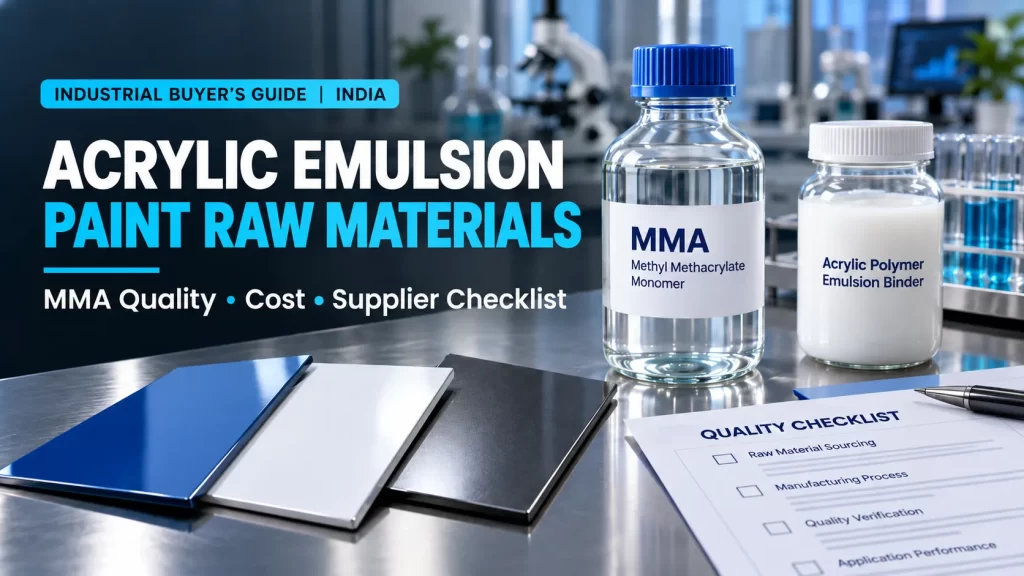
Choosing the right acrylic emulsion paint raw materials is a procurement decision, not simply a formulation exercise. Indian paint and acrylic emulsion manufacturers must balance material consistency, production yield, finished-coating performance, and landed cost. Low-priced inputs can become expensive when batches are rejected.
The practical solution is to identify the manufacturing stage first, specify critical quality parameters, and compare suppliers on total usable cost. This guide explains which materials belong in acrylic polymer production versus finished paint blending, how to assess regenerated Methyl Methacrylate (R-MMA), and how to request a useful bulk quotation.
Which Acrylic Emulsion Paint Raw Materials Does Your Factory Actually Need?
The answer depends on what you manufacture. Acrylic emulsion producers purchase monomers and polymerization auxiliaries; finished paint manufacturers usually purchase an already-produced acrylic binder alongside pigments, fillers, and additives.
Manufacturing operation | Main input categories | Buyer’s immediate concern |
Acrylic polymer emulsion production | MMA and other selected monomers, emulsifiers, initiators, water | Monomer quality, reaction consistency, binder properties |
Finished water-based paint blending | Acrylic emulsion binder, titanium dioxide, extenders, water, functional additives | Hiding power, viscosity, application performance, unit cost |
MMA is generally polymerized before the resulting acrylic binder is used in ordinary water-based paint. It should not be treated as a standard direct-addition ingredient in finished paint.
This distinction helps buyers shortlist acrylic emulsion paint raw materials without confusing feedstocks with ready-to-use formulation ingredients.
Main Raw Material Groups and Their Purchasing Roles
The following groups cover common acrylic emulsion paint raw materials, although grades depend on the end product.
Inputs for Acrylic Binder Manufacturing
- Methyl Methacrylate (MMA): A hard monomer used in selected acrylic copolymers.
- Butyl acrylate or other soft monomers: Help formulators adjust flexibility and film-formation behaviour.
- Emulsifiers and initiators: Support a controlled emulsion polymerization process.
- Process water and other auxiliaries: Require specifications appropriate to the production system.
MMA and butyl acrylate can be combined to target glass transition temperature (Tg); their proportions require formulation development. Published coatings research describes this hard-monomer/soft-monomer approach.
Inputs for Finished Emulsion Paint
- Acrylic binder: Forms the coating film and supports adhesion.
- Titanium dioxide: Provides whiteness and opacity.
- Calcium carbonate or china clay: Functions as extender and influences texture and cost.
- Dispersants, thickeners, defoamers and preservatives: Manage stability, rheology, processing and storage.
When evaluating acrylic emulsion raw material suppliers in India, check the product range: MMA Chemicals supplies regenerated MMA monomer, not every ingredient listed. Paint blenders seeking only binders need a binder supplier.
How Does MMA Quality Affect Acrylic Emulsion Production?
Methyl Methacrylate (CAS 80-62-6) is a raw material for acrylic polymers. In a suitable copolymer formulation, MMA contributes hardness while softer monomers help control flexibility and film formation.
When evaluating acrylic emulsion paint raw materials, polymer manufacturers should treat monomer specifications and process compatibility as linked decisions. Similar-purity batches may differ in moisture, inhibitors, or impurities.
Specifications to Request Before a Trial
Ask the prospective supplier for:
- A current technical specification and batch-specific Certificate of Analysis (CoA).
- MMA purity and the analytical method used.
- Moisture, appearance, density, and relevant impurity information.
- Inhibitor type and concentration, where specified.
- Safety Data Sheet (SDS), packaging details, and traceability information.
MMA Chemicals reports minimum 98.50% purity for its regenerated MMA. Its published quality process includes gas chromatography, Karl Fischer moisture analysis, and density measurement. These supplier-reported details do not guarantee compatibility with every formulation.
Review the company’s MMA monomer product details and quality-control information before discussing an industrial trial.
What Determines Acrylic Emulsion Paint Raw Materials Cost in India?
The main cost question is not “Which raw material has the lowest invoice price?” It is “Which approved material gives us the lowest repeatable cost per saleable batch?”
Four Cost Drivers to Compare
- Chemical specification: Monomer purity, binder performance, and pigment grade affect the available supplier options.
- Order structure: Drum, tanker, or ISO-tank requirements influence packaging, inventory, and receiving arrangements.
- Delivered price: Freight, duties where applicable, taxes, unloading, and handling change the landed cost.
- Manufacturing losses: Additional analysis, unsuitable batches, rework, and downtime increase effective material cost.
A basic procurement equation is:
Effective cost per usable kilogram = total delivered and quality-related expenditure ÷ quantity accepted for production.
For acrylic emulsion paint raw materials, compare quotations using the same grade, quantity, delivery destination, payment terms, and acceptance criteria. Do not present a national “MMA price per kg” as a fixed rate; request a current quantity-specific offer.
A More Useful RFQ Than “Send Best Price”
When contacting methyl methacrylate suppliers in India, state monthly volume, destination, packaging, trial quantity, and acceptance limits.
Quality Checklist for Acrylic Emulsion Paint Raw Materials: Regenerated MMA
Regenerated MMA is recovered and purified for reuse as a monomer feedstock. Its origin alone cannot establish polymerization performance.
Use this qualification sequence for acrylic emulsion paint raw materials:
Step 1: Screen the Documentation
Check the proposed grade against your approved raw-material standard. Confirm purity, moisture, stabilizer information, and any impurity limits that matter for the specific reactor process.
Step 2: Test an Incoming Sample
Your laboratory should verify the parameters relevant to your formulation. A supplier CoA supports screening, but it does not replace independent incoming inspection when your quality system requires it.
Step 3: Run a Controlled Production Trial
Compare the proposed monomer with your approved benchmark under your normal validated process. Depending on the product, assess polymerization behaviour, residual monomer, viscosity, solids content, particle stability, and resulting binder performance.
Step 4: Approve Repeat Supply
Document acceptance criteria, traceability, delivery terms, and nonconforming-batch handling. Consider multiple trials for consistency.
Safety note: MMA is a flammable, potentially reactive chemical. Follow the applicable SDS and plant procedures for stabilizer management, storage, ventilation, handling, and transport. The NIOSH methyl methacrylate guide provides independent hazard information.
Why Discuss Your Requirements With MMA Chemicals?
MMA Chemicals is the industrial brand of DD Enterprises, based in the Rajkot district of Gujarat. The company describes its product as regenerated MMA purified through depolymerization, neutralization, and distillation. Its site lists industrial drum, ISO-tank, and tanker supply options; actual suitability, order minimums, and dispatch availability should be confirmed for each inquiry.
For buyers comparing acrylic emulsion paint raw materials, this creates a specific sourcing option: request regenerated MMA monomer for technical evaluation, rather than an unverified promise that one grade suits every acrylic formulation.
Review the industrial MMA supply page before enquiring.
Information to Include in Your MMA Inquiry
- Company name and manufacturing application.
- Monthly or annual MMA volume and initial trial requirement.
- Required purity and other key acceptance parameters.
- Preferred packaging and delivery city in India.
- Request for a technical specification, recent CoA, SDS, and bulk quotation.
Frequently Asked Questions
For finished paint, they generally include acrylic binder, water, pigments, extenders, and functional additives. Acrylic binder producers instead need selected monomers, emulsifiers, initiators, and process water. Specify which manufacturing stage you operate before requesting quotations.
Not as a routine substitute for prepared acrylic binder. MMA is normally used upstream in polymer synthesis, where reaction conditions convert monomers into the binder polymer. Use only a professionally validated formulation and process.
Potentially. Approval depends on impurity profile, inhibitor concentration, moisture, process compatibility, and trial results. A purity percentage alone cannot establish performance or interchangeability with an existing grade.
The requested quality grade, order quantity, packaging, freight, delivery terms, and market conditions all influence quotations. Compare offers on a matched technical and commercial basis rather than treating a published price as permanent.
Ask for the technical specification, recent batch CoA, SDS, packaging details, traceability information, and commercial quotation. Include your application and acceptance limits so the supplier can assess the request accurately.
Conclusion: Buy for Proven Production Performance
Sourcing acrylic emulsion paint raw materials effectively means separating monomers from finished paint ingredients, understanding landed cost, and qualifying chemical batches against your own process requirements.
If your factory manufactures acrylic binders or emulsions and is evaluating regenerated MMA, MMA Chemicals can discuss specifications, packaging, availability, and pricing for your stated requirement. Qualification trials remain essential.
Email: sales.ddenterprise.com@gmail.com
Phone: +91 93743 34455 / +91 99090 18556