Acrylic Resin Raw Materials in India: Selection, Cost and Production Guide
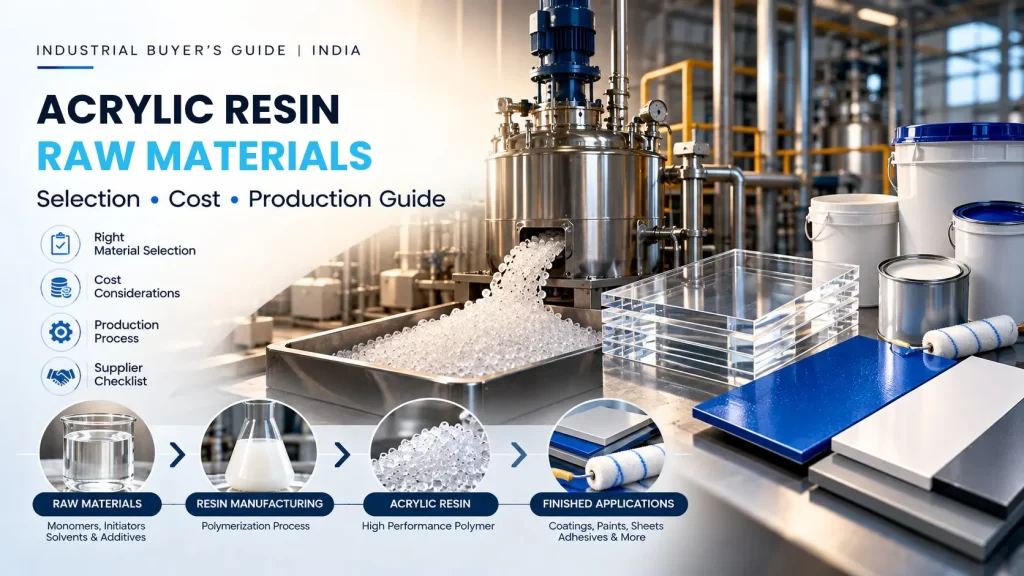
Acrylic resin raw materials fall into five groups: monomers (mainly methyl methacrylate, butyl acrylate and acrylic acid), initiators, solvents or water, chain transfer agents and additives. For acrylic resin manufacturing in India, pick the monomer blend by target glass transition temperature (Tg) first. Then compare suppliers on purity, inhibitor control and landed cost, not price alone.
A single off-spec monomer lot can spoil a whole resin batch, and the loss shows up only after the reactor run. This guide shows how to select acrylic resin raw materials, what drives their cost in India, and which production checks protect yield. You get a monomer table, a worked Tg example, a cost lever list and a supplier checklist.
What Are Acrylic Resin Raw Materials?
Acrylic resin raw materials are the chemicals that react to build an acrylic polymer. Every recipe uses the same five groups:
- Monomers: form the polymer backbone.
- Initiators: start polymerization. Examples are AIBN, benzoyl peroxide and ammonium persulfate.
- Solvent or water: carries the reaction and sets solids and viscosity.
- Chain transfer agents: control molecular weight. n-Dodecyl mercaptan is common.
- Additives: surfactants, neutralizers, inhibitors and crosslinkers.
Core Monomers and What They Do
Each monomer in your acrylic resin raw materials list changes the resin in a predictable way. Use this table as a starting map.
Monomer | Type | Main effect on resin |
Hard | Raises Tg, hardness, clarity, weathering resistance | |
Butyl acrylate (BA) | Soft | Lowers Tg, adds flexibility and tack |
2-Ethylhexyl acrylate (2-EHA) | Soft | Flexibility, water resistance, adhesive grades |
Acrylic acid, methacrylic acid | Functional | Adhesion, pigment wetting, water dispersibility |
HEMA, HEA | Hydroxyl functional | Crosslinking with isocyanates or melamine |
Glycidyl methacrylate (GMA) | Epoxy functional | Crosslinking and adhesion |
Styrene | Hard, low cost | Cuts cost, reduces outdoor durability |
How to Select Acrylic Resin Raw Materials by Resin Type
Select in three steps. Define the end use. Set the Tg target. Then add only the functional monomers the application needs.
Tg follows the Fox equation. PMMA has a Tg of about 105 °C and poly(butyl acrylate) about minus 55 °C (typical Polymer Handbook values). A blend of 70 parts MMA and 30 parts BA calculates to roughly 37 °C, a hard but film-forming balance. Functional monomers shift this slightly, so confirm in the lab.
The typical raw material for acrylic resin differs by system:
- Solvent-borne coating resin: MMA, BA, small amounts of HEMA and acrylic acid, a peroxide initiator, xylene or butyl acetate, and a mercaptan.
- Water-borne emulsion: MMA or styrene with BA, methacrylic acid, persulfate, surfactant and buffer. See our page on acrylic emulsion paint.
- Binders and adhesives: BA or 2-EHA rich blends. Read about the acrylic binder range.
- Cast sheet syrup: high-purity MMA. Our guide to chemicals for cast acrylic sheet covers it.
Choosing Initiators and Solvents for Acrylic Resin Raw Materials
Match the initiator to your reaction temperature. AIBN has a 10-hour half-life near 65 °C, while benzoyl peroxide sits near 73 °C. A mismatch gives slow conversion or a runaway exotherm.
In solution polymerization the solvent boiling point sets the reflux temperature. Xylene (about 140 °C) allows a hotter process than ethyl acetate (about 77 °C).
What Drives the Cost of Acrylic Resin Raw Materials in India?
Five levers decide the real cost of acrylic resin raw materials per kilogram of finished resin:
- Monomer price. Acrylates follow petrochemical feedstocks and global supply, so quotes move. Ask for landed INR per kg, not ex-works headline rates.
- Logistics. Freight, packaging (drums, IBCs or ISO tanks), port handling, GST and payment terms add up. Gujarat buyers benefit from nearby ports. Our Rajkot works sit about 120 km from Navlakhi, 189 km from Pipavav, 202 km from Kandla and 243 km from Mundra.
- Yield loss. Off-spec batches, residual monomer and gelled reactors cost more than a small price gap.
- Solvent recovery. Reusing recovered solvent lowers the cost of solvent-borne grades.
- Monomer source. Regenerated MMA can cut cost where the application tolerates it. Compare virgin vs regenerated monomers and the cost benefits of regenerated MMA.
Need a quote or sample? Call +91 93743 34455 or +91 99090 18556, email sales.ddenterprise.com@gmail.com, or send an inquiry.
Acrylic Resin Production: Checks That Protect Yield
Good acrylic resin production depends on handling as much as chemistry. Treat acrylic resin raw materials as flammable, inhibited and temperature sensitive.
- Keep oxygen present. MMA ships with an inhibitor, commonly MEHQ, which needs dissolved oxygen to work. Do not store inhibited monomer under pure nitrogen.
- Respect the flash point. MMA flashes near 10 °C. Use earthed, flameproof equipment and good ventilation. Follow our MMA storage and handling guide, and see the PubChem entry for methyl methacrylate for hazard data.
- Control the exotherm. Polymerization releases heat. Use a semi-batch monomer feed with cooling, not an all-in-one charge.
- Watch impurities. Water, acids and metal ions reduce initiator efficiency and affect colour.
- Test every batch. Track solids, viscosity, acid value, residual monomer by gas chromatography and molecular weight by GPC.
Check current Bureau of Indian Standards requirements, SDS availability and hazardous chemical storage rules for each material before you scale.
Common Mistakes With Acrylic Resin Raw Materials
- Buying on price per kg while ignoring inhibitor level and water content.
- Blending monomer lots without retesting.
- Storing monomer warm or in direct sun.
- Relying on one source with no approved backup.
- Changing initiator brand without checking half-life.
Choosing an Acrylic Resin Raw Material Supplier in India
A reliable acrylic resin raw material supplier proves consistency, not just a low quote. Ask for:
- A certificate of analysis for each lot: purity, water, acidity, colour and inhibitor level.
- Stated shelf life and storage guidance.
- A sample and permission to run a trial batch.
- ISO 9001 certification and batch traceability.
- Stock and packaging options that match your monthly volume.
Use this table to compare any acrylic resin raw materials quote on the same basis. Ask every supplier to state the last column for each lot.
Parameter | Why it matters | Usual test | Ask the supplier to state |
Purity | Sets conversion and molecular weight | Gas chromatography | Per-lot value and minimum limit |
Water | Disturbs initiators and emulsions | Karl Fischer | Per-lot value and maximum limit |
Acidity | Shifts pH and reaction rate | Titration | Per-lot value and maximum limit |
Inhibitor (MEHQ) | Sets storage life and induction time | UV or HPLC | Level in ppm |
Colour | Flags contamination and clarity risk | APHA scale | Per-lot value |
Also read how to choose MMA monomer quality before you shortlist suppliers.
Where MMA Chemicals Fits
MMA Chemicals (DD Enterprises) makes regenerated and crude MMA monomer, one of the key acrylic resin raw materials, at its factory in Hadamtala, Gondal, Rajkot, Gujarat. The company states a minimum 98.50% purity, ISO 9001:2015 certification and more than 50 years in the chemical industry. Qualify any MMA grade, virgin or regenerated, against your own specification in a lab trial first. For volume planning, see MMA bulk supply in India.
Frequently Asked Questions
The main acrylic resin raw materials are monomers such as methyl methacrylate, butyl acrylate and acrylic acid, plus an initiator, solvent or water, a chain transfer agent and additives. The monomer blend sets hardness, flexibility and adhesion.
It depends on the target. MMA drives hardness and clarity. Butyl acrylate drives flexibility. Most resins need both, tuned to a target Tg.
Compare landed cost, cut off-spec batches, recover solvent and qualify regenerated MMA where your application allows it.
Often yes, if it meets your purity, colour, water and inhibitor limits. Validate it with a pilot batch before full-scale use.
Qualify at least two suppliers, test every incoming lot against a written specification, and agree packaging and lead times in advance.
Conclusion
Choosing acrylic resin raw materials well comes down to three habits. Match monomers to the Tg you need, judge cost beyond the quote, and protect yield with disciplined handling. Start with your target resin, shortlist suppliers who share lot-level data, and run a trial batch.
Ready to qualify an MMA grade? Request a sample and certificate of analysis from MMA Chemicals. Call +91 93743 34455 or +91 99090 18556, contact our team, explore our regenerated MMA monomer range, or download the company profile.