
R-MMA for PMMA Manufacturing: Raw Material Selection Guide
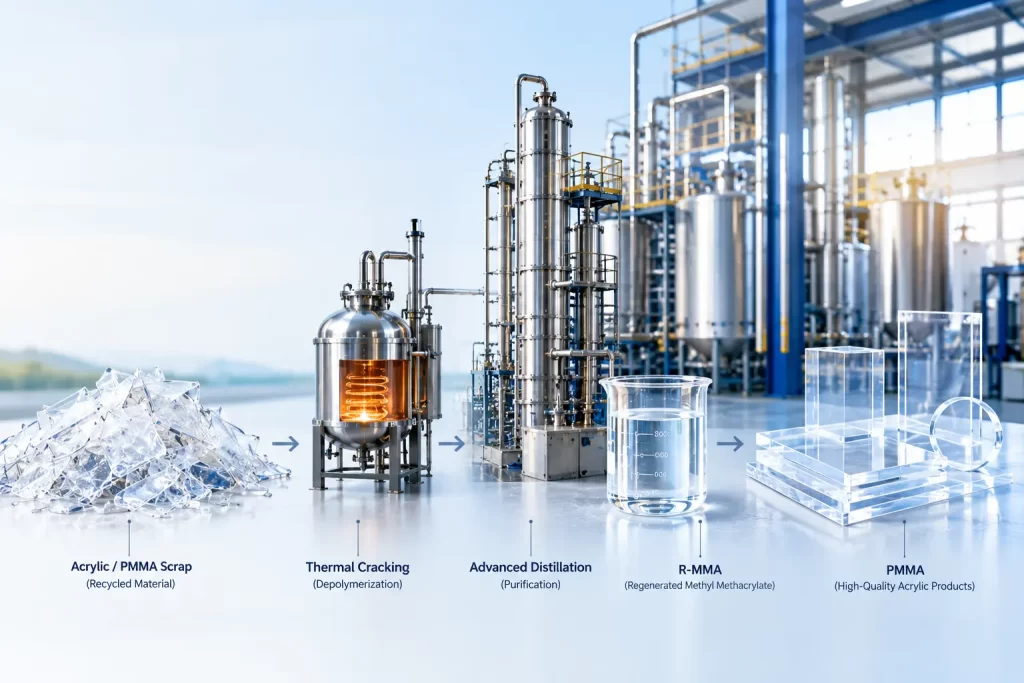
Choosing the right chemicals for production is crucial. Raw materials impact the clarity, strength, and lifespan of acrylic products.
This guide helps you evaluate raw materials and shows how switching to regenerated monomer can boost efficiency. You’ll learn the specs needed for high-grade polymerization, how to find a reliable supplier, and the benefits of recycled inputs.
The Bottom Line: Using high-purity R-MMA for PMMA offers the same clarity and stability as virgin monomer, but at a better price and with less environmental impact.
The Core of Acrylic Production: Why R-MMA for PMMA is the Future
Polymethyl methacrylate, or PMMA, is known for its clarity, weather resistance, and strength. The quality of acrylic sheets and resins depends on the purity of its main ingredient: methyl methacrylate monomer.
Traditionally, manufacturers used virgin monomer from petrochemical sources. Now, advanced distillation and depolymerization techniques have changed the game. High-quality R-MMA for PMMA has the same molecular structure as virgin monomer.
When you buy from a top regenerated MMA supplier, you get a product that has been cracked, purified, and returned to its original state. This helps maintain quality while lowering costs.
Raw Materials Used in PMMA Manufacturing
To appreciate regenerated inputs, you need to know the raw materials in PMMA manufacturing. The free-radical polymerization process is sensitive. It requires precise thermal conditions and exact chemical balances to avoid cloudiness, yellowing, or weakness in the final product.
The main ingredient is the MMA monomer. Buyers must consider how the entire formula interacts when selecting methyl methacrylate for PMMA production.
The Essential Chemical Components
- The Base Monomer: The main ingredient that creates long polymer chains. High-purity MMA is crucial.
- Initiators: Special agents like peroxides or azo compounds that trigger polymerization.
- Chain Transfer Agents: Control the molecular weight of the polymer, ensuring correct flow properties.
- Cross-linking Agents: Improve heat and solvent resistance in cast acrylics.
- UV Stabilizers and Colorants: Protect against sun damage and enhance aesthetics.
When evaluating R-MMA for PMMA, it must work well with these agents. Impurities in recycled MMA can hinder the process or cause reactions. This is why sourcing from an advanced supplier is essential.
Virgin MMA vs. Regenerated MMA: A Technical Comparison
Many procurement officers hesitate to switch from virgin to regenerated chemicals due to misconceptions about depolymerization.
Recycled MMA isn’t just melted plastic. True R-MMA comes from a precise process called thermal cracking. Acrylic scrap is heated in a reactor to break down polymer chains into methyl methacrylate. The resulting liquid is distilled to remove additives, pigments, and moisture.
To highlight this material’s viability, see the technical data below.
Chemical Specification Benchmarking Table
Technical Metric | Virgin Methyl Methacrylate | Premium R-MMA for PMMA | Industry Standard Requirement |
Chemical Formula | C5H8O2 | C5H8O2 | C5H8O2 |
Monomer Purity | > 99.5% | > 99.5% | > 99.0% |
APHA Color Index | < 10 | < 10 | < 15 |
Moisture Content | < 0.05% | < 0.05% | < 0.10% |
Acid Value (as MAA) | < 0.005% | < 0.005% | < 0.01% |
Specific Gravity | 0.940 – 0.944 | 0.940 – 0.944 | 0.940 – 0.944 |
Primary Source | Petrochemical Extraction | Chemical Depolymerization | N/A |
Since the molecular formula is the same, methyl methacrylate for PMMA behaves the same in the reactor, whether virgin or regenerated.
Key Criteria for Choosing a PMMA Raw Material Supplier
Your supply chain affects production stability. If your supplier has issues, your factory may stop. When looking for a methyl methacrylate supplier, assess them for chemical quality and reliability.
1. Advanced Distillation Capabilities
Not all regenerated MMA is equal. A trustworthy supplier should have state-of-the-art fractional distillation columns. This equipment separates pure monomer from heavier oligomers and cross-linking agents. Always ask about their distillation process and request a Certificate of Analysis (CoA) for recent batches.
2. Consistency in Batch Quality
In chemical manufacturing, consistency is as crucial as purity. If one batch of R-MMA has 99.8% purity and the next drops to 98.5%, engineers will need to adjust their ratios. A top MMA monomer supplier in India should ensure batch consistency through rigorous testing and standard procedures.
3. Sustainable Sourcing Practices
The main advantage of using a regenerated MMA supplier is sustainability. Ensure your supplier has a steady pipeline of quality acrylic scrap. Their ability to source premium scrap affects the volume and purity of R-MMA they provide.
The PMMA Manufacturing Process: Integration Strategies
Integrating R-MMA for PMMA into your production lines doesn’t need a complete overhaul. Since the chemical properties match virgin materials, the switch is efficient. Your polymerization method will determine specific handling needs.
Cast Acrylic Sheet Production
Cell casting is the premium method for architectural acrylic sheet manufacturing. The MMA monomer is poured into tempered glass molds and cured in warm water. Since cast acrylic requires controlled polymerization, the purity of the monomer is vital.
Using R-MMA for PMMA in cell casting ensures the final sheet is free of bubbles, distortions, and yellowing due to its low moisture content and color index.
Continuous Extrusion Production
In extrusion, PMMA is first polymerized in bulk to create solid pellets. These pellets are melted and forced through a die to make continuous plastic sheets. Extruded acrylic is thinner and used for display cases, lighting panels, and signage.
Using recycled MMA for PMMA production in resins offers major cost savings. Bulk polymerization easily accepts high-grade R-MMA, allowing manufacturers to lower costs while maintaining excellent quality.
The Commercial Advantage: Why Choose an MMA Monomer Supplier in India
The global petrochemical supply chain is volatile. Geopolitical events and crude oil price changes affect virgin methyl methacrylate costs. Partnering with a domestic MMA monomer supplier in India can help protect you from these market swings.
Cost Predictability and Margin Control
Regenerated MMA separates your raw material costs from crude oil fluctuations. Since R-MMA comes from acrylic scrap, pricing remains stable. This stability helps plant managers and procurement teams forecast budgets accurately.
Supporting the Circular Economy
Modern consumers demand sustainable practices. Using R-MMA for PMMA allows your company to market products as eco-friendly. This reduces landfill waste and carbon emissions from virgin extraction. It gives your sales team a strong narrative for eco-conscious contracts.
Overcoming Common Objections
Despite clear benefits, some plant managers hesitate to switch to regenerated materials. We must address these concerns…
Objection 1: Regenerated monomer has a strong, unpleasant odor.
Low-grade recycled MMA can have a bad smell due to impurities. But premium R-MMA doesn’t have this problem. Advanced fractional distillation removes the volatile compounds that cause odors. High-purity MMA for acrylic sheet production looks and smells just like virgin MMA.
Objection 2: R-MMA will naturally yellow over time.
Yellowing in acrylic happens from UV degradation or trapped impurities. Premium R-MMA for PMMA has an APHA color index below 10 and a purity over 99.5 percent. This means it performs like virgin material under UV stress. Adding standard UV stabilizers during production will ensure long-lasting clarity for outdoor use.
Conclusion: Transform Your Manufacturing with Premium R-MMA
The acrylic industry is evolving quickly. Relying solely on costly virgin petrochemicals is no longer sustainable. To stay competitive, you need raw materials that guarantee high quality, stable pricing, and environmental sustainability.
Using high-grade R-MMA for PMMA helps meet these goals. By partnering with a reliable supplier, you can produce flawless acrylics and boost your profits.
Ready to enhance your PMMA manufacturing? Contact MMA Chemicals today for a detailed Certificate of Analysis, request a bulk sample, and discover how our premium regenerated MMA can transform your production.
Frequently Asked Questions (FAQ)
Yes. High-purity R-MMA for PMMA is distilled to ensure an APHA score under 10 and over 99.5 percent purity. This makes it ideal for transparent optical-grade acrylic sheets.
No, the formula is the same. Regenerated MMA is made by thermally cracking acrylic polymer back into methyl methacrylate (C5H8O2). It is chemically identical to virgin monomer.
Sourcing regenerated MMA usually lowers raw material costs. It offers stable pricing that is less affected by crude oil market fluctuations than virgin petrochemicals.
No. The molecular structure and purity are the same as virgin materials. You won't need to change your existing initiators or manufacturing processes. R-MMA fits seamlessly into your current polymerization process.