
The Chemistry of MMA Monomers: What You Need to Know for Your Business
Introduction
Businesses that use Methyl Methacrylate (MMA) monomers must understand their chemical properties and regeneration process. In addition, MMA monomers play an important role in manufacturing plastics, coatings, adhesives, and acrylic products.
The chemical structure of MMA directly affects product strength, durability, and performance. Therefore, manufacturers must maintain consistent monomer quality during production and recycling.
In this technical guide, we’ll explain the basics of MMA chemistry and the regeneration process. Furthermore, we’ll show how regenerated MMA maintains industrial performance and supports sustainable manufacturing practices.
As a result, businesses can make informed decisions when selecting recycled MMA solutions for industrial applications.
Understanding the Basics of MMA Monomers
Methyl Methacrylate (MMA) is a versatile chemical compound used to produce polymethyl methacrylate (PMMA), also known as acrylic plastic. In addition, manufacturers use MMA in many industrial and commercial applications because of its strength and clarity.
MMA offers excellent transparency, durability, and UV resistance. Therefore, it is suitable for products that require long-lasting performance and weather resistance.
The chemical structure of MMA contains a methyl group attached to a methacrylate backbone. As a result, MMA provides high optical clarity, strong surface performance, and good environmental resistance.
The Chemical Properties of MMA Monomers
MMA monomers offer several important chemical properties that support industrial performance and product durability. In addition, these properties make MMA suitable for plastics, coatings, automotive parts, and acrylic applications.
- Molecular Weight: MMA has a relatively low molecular weight. As a result, manufacturers can easily polymerize it into PMMA.
- High Clarity and Transparency: PMMA made from MMA provides excellent optical clarity. Therefore, industries often use it for signage, display panels, acrylic sheets, and automotive components.
- UV Resistance: MMA-based plastics and coatings offer strong UV resistance. In addition, they help prevent yellowing and surface degradation over time.
- High Impact Resistance: PMMA also delivers strong impact resistance. Because of this, manufacturers use it in applications that require strength, durability, and long-term performance.
Understanding these properties helps businesses choose the right monomers for specific industrial and commercial applications.
The Role of Regeneration in Maintaining MMA Performance
Depolymerization and Chemical Recovery
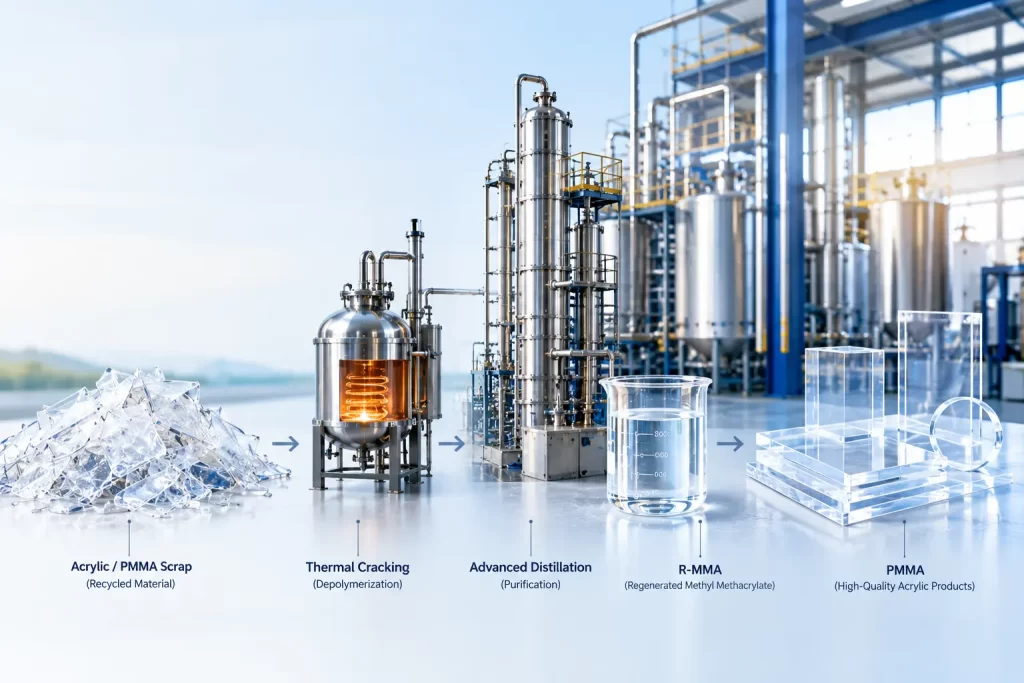
One important process in MMA regeneration is depolymerization. During this process, manufacturers break down waste materials that contain MMA into basic monomer units.
Depolymerization reverses the polymerization reaction and separates the polymer chains. As a result, manufacturers can recover reusable MMA monomers from acrylic waste materials.
Furthermore, this chemical recovery process helps regenerated MMA maintain properties similar to virgin MMA. Therefore, regenerated monomers can deliver reliable performance in industrial applications.
Purification and Quality Control
After depolymerization, manufacturers purify the recovered monomers to remove impurities and improve product quality. In addition, purification helps maintain the strength, clarity, and durability of regenerated MMA.
Manufacturers use advanced processes such as distillation and filtration to achieve high-purity regenerated monomers. As a result, regenerated MMA can match the performance of virgin MMA in many applications.
Furthermore, quality control testing helps verify that regenerated MMA meets industry standards and delivers consistent performance in demanding industrial environments.
Applications of MMA Monomers in Various Industries
MMA monomers support many industrial applications because of their versatile chemical properties. In addition, manufacturers use MMA in products that require clarity, durability, and strong weather resistance.
- Automotive Industry: Manufacturers use MMA-based plastics to produce transparent and impact-resistant parts such as headlights, taillights, and sunroofs. As a result, automotive components remain durable and visually clear.
- Construction and Building Materials: PMMA sheets made from MMA are commonly used for skylights, windows, and noise barriers. Furthermore, these materials provide excellent clarity and weather resistance for outdoor applications.
- Coatings and Adhesives: Manufacturers also use MMA monomers to create durable coatings and adhesives. Therefore, these products offer strong bonding performance and long-lasting surface protection.
By understanding the chemistry and performance of MMA monomers, businesses can choose suitable materials for different industrial and commercial applications.
Key Considerations for Choosing Regenerated MMA
Businesses should evaluate several important factors before selecting regenerated MMA monomers. In addition, choosing high-quality regenerated MMA helps improve product performance and sustainability.
- Purity and Performance: Businesses should verify that the regenerated MMA has completed proper purification and quality testing. As a result, the material can deliver performance similar to virgin MMA.
- Cost Efficiency: Regenerated MMA often costs less because manufacturers use recycled raw materials during production. Therefore, businesses can optimize production costs without reducing product quality.
- Sustainability: Using regenerated MMA supports a circular economy by reducing waste and conserving natural resources. Furthermore, recycled MMA helps companies achieve environmental and sustainability goals.
Conclusion: Leveraging MMA Chemistry for Business Success
Understanding the chemistry of MMA monomers and the regeneration process helps businesses choose the right materials for industrial applications. In addition, regenerated MMA allows companies to maintain product quality while improving sustainability and cost efficiency.
Businesses can also benefit by partnering with a reliable R-MMA monomer supplier in India. As a result, companies receive high-quality regenerated MMA that meets specific production and performance requirements.
Manufacturers in the automotive, construction, and coatings industries can use regenerated MMA for durable and high-performance products. Furthermore, understanding MMA chemistry and regeneration helps businesses make informed decisions that support long-term growth and operational success.
Frequently Asked Questions
Here are the frequently asked questions (FAQs) that provide essential information about The Chemistry of MMA Monomers: What You Need to Know for Your Business
Evaluate the quality by checking key indicators like purity, physical properties, and compliance standards. Verify the supplier’s testing methods, batch consistency, and technical support.
Batch consistency ensures that each batch of regenerated MMA meets the same quality standards, reducing the risk of defects in your final products and maintaining production efficiency.
Look for certifications like ISO 9001 (quality management), ISO 14001 (environmental management), and compliance with industry-specific standards such as REACH and RoHS.
How Is Methyl Methacrylate Produced? MMA Production Process
How Is Methyl Methacrylate Produced? MMA Production Process Methyl Methacrylate (MMA) is one of the most important raw materials used […]
25 Acrylic Sheet Applications Across Industries in 2026
25 Acrylic Sheet Applications Across Industries in 2026 Acrylic sheets have become one of the most practical materials for modern […]
Methyl Methacrylate Market Trends, Demand & Future Growth
Methyl Methacrylate Market Trends, Demand & Future Growth The global MMA market continues to expand as industries increasingly adopt advanced […]