
MMA Chemicals

Top 5 Uses & Facts About MMA Monomer You Should Know in 2025

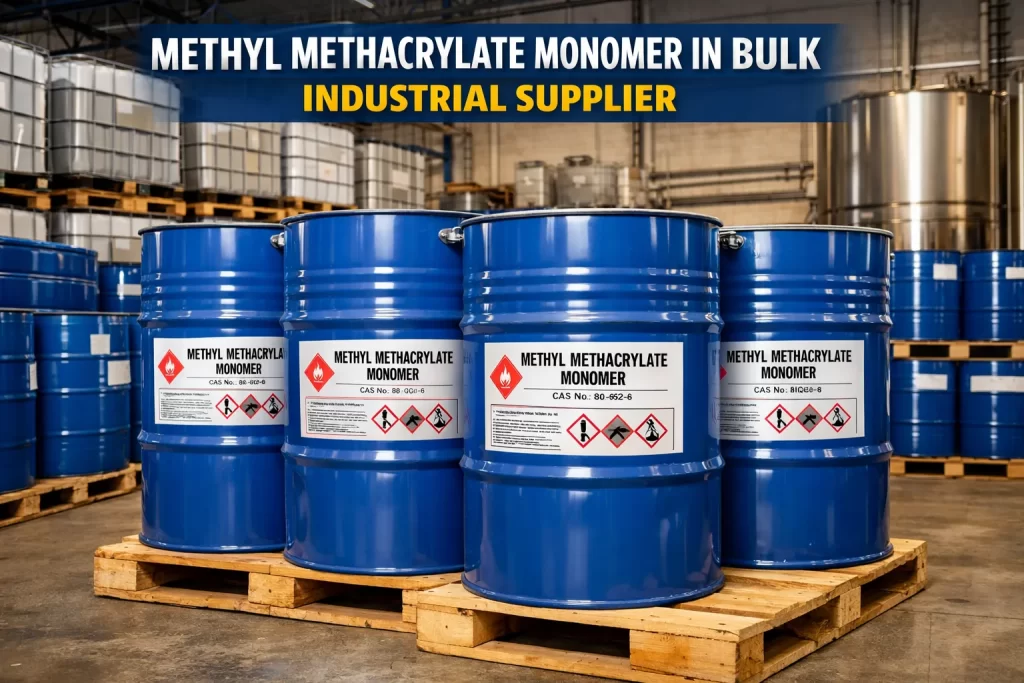
Export-ready cylindrical containers labeled “MMA Monomer” stacked on pallets in an industrial warehouse, prepared for international shipping.

Top 5 Uses & Facts About MMA Monomer You Should Know in 2025

What is MMA Monomer?

MMA Monomer, or methyl methacrylate, is a versatile and high-performance monomer primarily used in the production of acrylic-based polymers. It’s a clear, colorless liquid known chemically as the methyl ester of methacrylic acid. MMA Monomer serves as a key component in the manufacturing of products such as acrylic sheets, surface coatings, adhesives, sealants, signage, impact modifiers, and more.


The Origins of Methyl Methacrylate

The development of MMA Monomer can be traced back to early explorations in acrylic chemistry during the 19th century. German researchers successfully synthesized acrylic acid in 1843, and later progressed to methacrylic acid. By combining methacrylic acid with methanol, chemists produced methyl methacrylate—a breakthrough that paved the way for what we now recognize as acrylic polymer.

It wasn’t until the 1930s, however, that the potential of MMA Monomer was fully realized, as advancements in polymerization led to the commercialization of acrylic materials. Today, MMA is widely used for its optical clarity, strength, and resistance to weathering and UV degradation.

In this article, we’ll take a closer look at five core facts that highlight the significance and performance of MMA Monomer in modern industrial applications.

1. Understanding the Fundamentals of MMA Monomer

MMA Monomer plays a foundational role in the synthesis of various acrylic and methacrylic copolymers. It is frequently used as a comonomer in formulations for paints, industrial coatings, adhesives, and high-performance plastics. Due to its chemical structure, MMA Monomer enhances key polymer properties including glass transition temperature (Tg), surface hardness, weatherability, and UV resistance.

In free-radical polymerization systems, MMA is valued for its ability to improve durability, clarity, and impact strength while maintaining excellent processability.

Key Physical and Chemical Properties of MMA Monomer:

Property Value
CAS Number
80-62-6
EC (EINECS) Number
201-297-1
Molecular Formula
C₅H₈O₂
Molecular Weight
100.12 g/mol
Melting Point
-48°C (-54°F)
Boiling Point
101°C (214°F)
Flash Point
2°C (36°F)
Tg of PMMA
105°C

In polymer applications, MMA Monomer contributes significantly to improved mechanical strength, scratch resistance, surface gloss, and optical transparency—qualities that are essential in demanding sectors like automotive, construction, electronics, and healthcare.

2. How MMA Monomer Polymerizes

The polymerization of MMA Monomer lies at the heart of its value across countless industries. Polymerization refers to the chemical process in which small molecules (monomers) join to form larger, more complex structures known as polymers. In the case of MMA Monomer, it can form both homopolymers (like PMMA) and copolymers when combined with other monomers.

Copolymer Versatility

MMA Monomer is commonly copolymerized with:

  • Butyl acrylate (BA)
  • 2-ethylhexyl acrylate (2-EHA)
  • Styrene
  • Methacrylic acid (MAA)
  • Acrylic acid (AA)
  • Other methacrylate esters

These combinations allow for custom tailoring of the polymer’s performance characteristics, such as glass transition temperature (Tg), flexibility, impact strength, or hardness—depending on the end-use application.

Control Over Resin Behavior

The Tg of the resulting polymer can range from -55°C to over 100°C, based on the chosen monomer ratios. For example:

  • MMA alone gives a Tg of ~105°C
  • Copolymerizing with soft monomers like 2-EHA (Tg ~ -55°C) reduces brittleness
  • Styrene and acrylic acid raise Tg and enhance strength or adhesion

This versatility makes MMA Monomer an indispensable component in high-performance coatings, adhesives, sealants, and engineered plastics.


3. Applications of MMA Monomer

MMA Monomer is an incredibly versatile material used to produce both homopolymers and copolymers, enabling a wide range of industrial and commercial applications. Its primary use is in manufacturing polymethyl methacrylate (PMMA)—a lightweight, impact-resistant, and optically clear plastic ideal for transparent sheets, safety glazing, and illuminated displays.

Key End-Use Areas:

  • Acrylic Sheets: Used in signage, displays, bath enclosures, and architectural panels due to excellent clarity, UV resistance, and strength.
  • Safety Glazing & Light Fixtures: PMMA formed from MMA Monomer offers shatter-resistant alternatives to glass in automotive, construction, and outdoor lighting.
  • Adhesives & Sealants: MMA-based adhesives cure rapidly, bond dissimilar materials, and maintain structural integrity under stress and temperature variation. They’re used in electronics, construction, and transportation.
  • Coatings & Paints: As a comonomer, MMA enhances weatherability, gloss retention, and film hardness in exterior paints, paper coatings, and industrial finishes.
  • Impact Modifiers: In PVC, MMA Monomer helps produce MBS resins that increase toughness and clarity for packaging, bottles, and rigid components.
  • Engineering Resins: Reactive MMA systems are used in low-viscosity, fast-curing concrete repair products, floor sealants, and chemical grouts.
  • Textiles & Inks: MMA copolymers contribute to the durability and flexibility of textile finishes and specialty inks.
  • Medical Devices: PMMA, derived from MMA, is biocompatible and widely used in intraocular lenses and bone cement.
  • Oil & Gas Industry: Copolymers of MMA are used as flocculants, waterproofing agents, and soil stabilizers.

Note on Safety

While MMA Monomer should be handled with care—avoiding skin, eye, and inhalation exposure—its polymerized form, PMMA, is stable and safe, including for use in healthcare and high-contact environments.


4. Composition of an Acrylic Emulsion Using MMA Monomer

To showcase the functional use of MMA Monomer, here’s an example of a typical acrylic emulsion polymer used in paint or coating applications. The formulation involves a structured monomer feed and initiator system that collectively influence the performance properties of the final emulsion, such as flexibility, film hardness, and durability.

Monomer Feed System A

This phase includes water, emulsifiers, and monomers blended for polymerization.

Component Amount (g) % of Total Polymer Weight
Deionized Water
372.0
Acrylic Acid (GAA)
4.6
0.9%
Styrene
74.6
15.1%
MMA Monomer
80.3
16.3%
Butyl Acrylate (BA)
195.2
39.5%
2-Ethylhexyl Acrylate
129.6
26.3%
Total Feed A Subweight:
~874 g

Initiator Feed System B

This system activates polymerization through a water-based oxidizing agent.

Component Amount (g) % of Total Polymer Weight
Deionized Water
34.6
Ammonium Persulfate
1.46
0.3%
Total Feed B Subweight:
~36.1 g
Combined Batch Total:
~1,000 g

Emulsion Characteristics:

Property Value
Glass Transition (Tg)
-12°C
Viscosity
~99 mPa·s
Acid Number
7.2 mg KOH/g
Particle Size
0.22 µm
pH (Adjusted with Ammonia)
~9.0
Non-Volatile Content
~0.5%

 This balanced formulation demonstrates how MMA Monomer functions as a hard segment in the polymer chain, enhancing durability, UV resistance, and gloss. Its synergy with softer monomers like BA and 2-EHA creates coatings that are both flexible and robust—ideal for exterior paints, sealants, and high-performance finishes.

5. Safety, Handling & Technical Specifications of MMA Monomer

When working with MMA Monomer, safety must be a top priority due to its chemical reactivity and health risks. It is a flammable, colorless liquid with a boiling point of 101°C and a melting point of -48°C. While readily soluble in organic solvents, MMA is insoluble in water.

Handling Considerations

Direct skin or eye contact can lead to irritation, and repeated exposure may cause allergic skin reactions. Inhalation of MMA vapor can irritate the respiratory system and—at high concentrations—pose serious health risks.

Due to its potential to polymerize violently, MMA Monomer is always delivered in a stabilized form. It must be stored with adequate ventilation and under air, to maintain dissolved oxygen levels and keep the inhibitor effective. Regular monitoring of storage conditions is essential.

High-Purity MMA Monomer from DD Enterprises

At DD Enterprises, we are proud to offer regenerated MMA Monomer of ≥99.9% purity, formulated to meet industrial-grade performance and safety requirements. Our MMA is stabilized with 15–18 ppm Topanol A, a low-volatility, FDA-compliant inhibitor that ensures safe storage without discoloration or residue.

We support clients in coatings, plastics, adhesives, construction, and specialty chemicals with consistent, high-quality MMA tailored for performance and sustainability.

Product Specifications – MMA Monomer

Parameter Specification
Appearance (25°C)
Clear, colorless liquid
Purity (by GC)
≥ 99.9%
Color (Pt-Co Scale)
≤ 5
Moisture (by K.F.)
≤ 0.02%
Acidity (as MAA)
≤ 0.0035%
Inhibitor (Topanol A)
15–18 ppm

Why Choose DD Enterprises?

As a trusted Indian manufacturer of regenerated MMA Monomer, DD Enterprises combines technical expertise, sustainable processes, and customer-centric service. Our facility is strategically located in Gujarat’s industrial hub, giving us a competitive edge in supply chain efficiency and cost-effectiveness.

We help manufacturers across multiple sectors reduce raw material costs without compromising on quality or regulatory compliance. Whether you’re looking for bulk MMA, technical support, or tailored formulations—we’re here to help.

Get in Touch with DD Enterprises

If you are sourcing high-purity MMA Monomer for industrial use and looking for a reliable partner, look no further than DD Enterprises. We are committed to delivering consistent quality, technical expertise, and eco-friendly solutions at scale.

📧 Email
contact@mmachemicals.com
hiral.sorathiya@yahoo.com

📞 Phone
+91 99090 18556

Let’s Collaborate

Whether you need bulk MMA Monomer, regenerated MMA samples, or simply have technical questions about compatibility and formulations, our team is ready to support you. Reach out to DD Enterprises today to discuss your specific requirements and unlock smarter, cleaner, and more cost-effective acrylic solutions.

Frequently Asked Questions

Here are the frequently asked questions (FAQs) that provide essential information about MMA Chemicals and our Methyl Methacrylate (MMA) Monomer products. These FAQs are designed to address common inquiries and help you understand why MMA Chemicals is the preferred choice for MMA Monomer.


How can I evaluate the quality of regenerated MMA monomers?

Evaluate the quality by checking key indicators like purity, physical properties, and compliance standards. Verify the supplier’s testing methods, batch consistency, and technical support.

Why is batch consistency important in regenerated MMA?

Batch consistency ensures that each batch of regenerated MMA meets the same quality standards, reducing the risk of defects in your final products and maintaining production efficiency.

What certifications should I look for in a regenerated MMA supplier?

Look for certifications like ISO 9001 (quality management), ISO 14001 (environmental management), and compliance with industry-specific standards such as REACH and RoHS.

CONTACT US

Get A Free Quote

Industrial MMA Monomer Price and Supply Options

Industrial MMA Monomer Price and Supply Options

High-Purity Chemical Manufacturing with a Focus on Speed and Reliability Methyl methacrylate (MMA) monomer is a critical raw material used […]

Buy Methyl Methacrylate Monomer for PMMA Manufacturing – Global Bulk Supplier

Buy Methyl Methacrylate Monomer for PMMA Manufacturing – Global Bulk Supplier

High-Purity Chemical Manufacturing with a Focus on Speed and Reliability Methyl Methacrylate (MMA) monomer is the essential raw material used […]
Buy Methyl Methacrylate Monomer for PMMA Manufacturing in India

Buy Methyl Methacrylate Monomer for PMMA Manufacturing in India

High-Purity Chemical Manufacturing with a Focus on Speed and Reliability Buy Methyl Methacrylate Monomer for PMMA Manufacturing in India Methyl […]

Leave a Comment

Your email address will not be published. Required fields are marked *

nine − 6 =

Scroll to Top